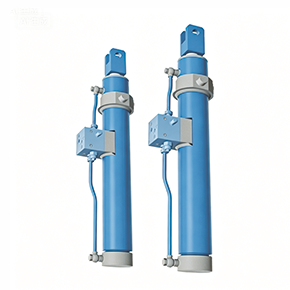
SCHWERLL A three‑chamber cylinder differs from a conventional hydraulic cylinder, which has only two chambers (rodless chamber/rod chamber), in that the three‑chamber hydraulic cylinder achieves… Hollow piston rod, built-in core column, or composite piston The design additionally incorporates a third chamber—typically the piston rod cavity, an auxiliary balance chamber, or an acceleration chamber—allowing independent or combined oil supply to all three chambers to achieve sophisticated motion control.
Three-chamber structure:
- A chamber (rodless chamber) : The main chamber below the piston, which extends the piston rod when oil is supplied, delivering maximum thrust.
- B chamber (rod chamber) : The chamber above the piston, which drives the piston rod to retract when oil is supplied.
- C Cavity (Third Cavity) : Typically located in the piston rod’s internal cavity or in a separate auxiliary chamber, it can be used to counterbalance gravitational loads, accelerate motion, or provide bidirectional symmetrical control.
The advantages of a three‑cavity hydraulic cylinder lie in… Multi-condition compatibility, high-precision control, and high load stability , the core application scenarios are as follows:
1. Pressworking equipment (punch presses, hydraulic presses, and hydraulic machines)
- It achieves multi‑stage motion—“rapid no‑load descent → slow high‑pressure stamping → rapid return”—significantly boosting production efficiency while reducing impact and energy consumption under high‑pressure operating conditions.
- For example, the three-chamber composite cylinder of a hydraulic press can achieve high-speed motion at low flow rates under no-load conditions by varying chamber configurations, while delivering substantial thrust for stable forming during pressurization.
2. Construction Machinery and Special-Purpose Vehicles
- Lifting, luffing, and telescoping mechanisms: By utilizing the balanced pressure in the third chamber to counteract the load’s self-weight, these systems ensure smooth start-up and stoppage during lifting operations, prevent unintended vehicle movement, and enhance operational safety.
- For example, the lifting cylinders of mining dump trucks and the luffing cylinders of aerial work platforms often employ a three-chamber design to balance lifting force with control stability.
3. High-Precision Testing and Servo Control Equipment
- Vibration test stands and material testing machines: By utilizing the symmetrical working surfaces of cavities A and C, they compensate for the area difference introduced by the piston rod, enabling symmetric control of thrust and velocity in both directions and enhancing test accuracy.
- The electro-hydraulic servo three-chamber cylinder delivers millisecond‑level response, meeting the testing requirements for dynamic loading and high‑frequency vibration, such as in wave compensation applications.
4. Heavy-duty industrial equipment
- Large-scale presses and forging equipment: By employing a three‑chamber, staged control system, they achieve an operational cycle of “rapid approach to the workpiece → slow, high‑pressure forming → rapid return,” thereby ensuring processing efficiency while preventing high‑pressure impacts that could damage the equipment.